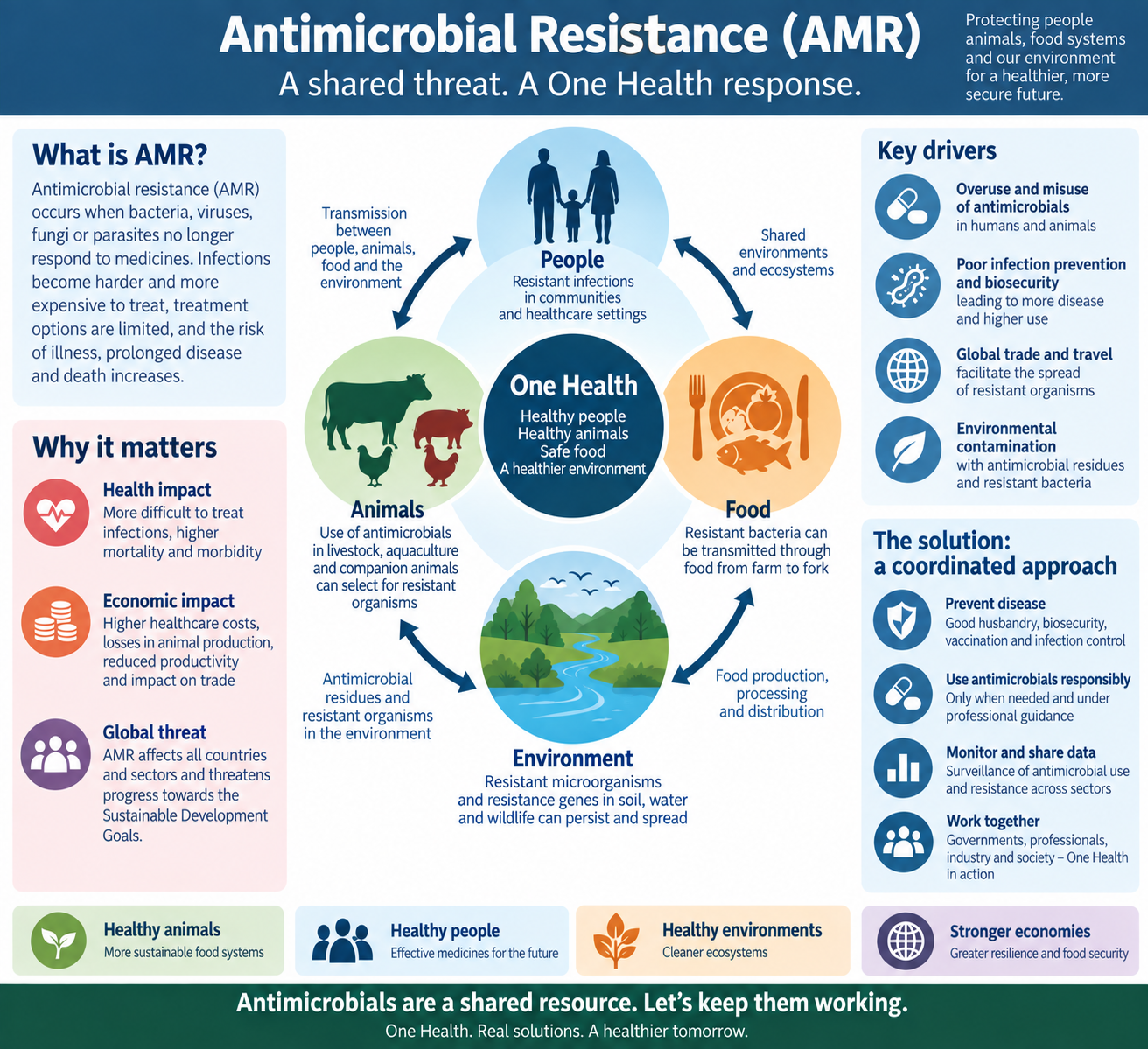
Antimicrobial Resistance (AMR)
Antimicrobial resistance is one of the major global threats to human health, animal health, food security and sustainable development.
Antimicrobials have transformed both human and veterinary medicine. However, their use creates selective pressure that can favour resistant microorganisms. When antimicrobial resistance develops and spreads, infections become more difficult and expensive to treat, treatment options become limited, illness may last longer and the risk of treatment failure and death increases.
AMR is therefore both a health challenge and an economic challenge. Its consequences extend beyond the treatment of individual infections to healthcare costs, livestock production, food systems, international trade and the wider economy.
Because resistant microorganisms and resistance genes can move between people, animals, food and the environment, antimicrobial resistance is fundamentally a One Health issue.
AMR Across the Human–Animal–Food Interface
Resistance does not respect institutional or sectoral boundaries.
Antimicrobials are used in human and veterinary medicine and, in some countries, also in animal and plant production. Resistant microorganisms can circulate within animal populations and human populations and may be transmitted through direct contact, food, water and the environment.
Effective action therefore requires cooperation between:
- human-health authorities;
- veterinary services;
- food-safety authorities;
- livestock and aquaculture sectors;
- veterinary and medical professionals;
- laboratories;
- pharmaceutical regulators;
- research institutions; and
- environmental authorities.
No individual sector can address AMR effectively on its own.
Animal Health and Antimicrobial Use
Antimicrobials remain important tools for protecting animal health and welfare. The objective of AMR policy is therefore not simply to eliminate their use, but to ensure that antimicrobials are used responsibly and only when justified.
Effective veterinary systems can contribute through:
- prevention of animal disease;
- improved farm biosecurity;
- vaccination;
- good husbandry and animal welfare;
- appropriate diagnosis;
- responsible prescribing;
- control of veterinary medicinal products;
- monitoring antimicrobial use;
- surveillance of antimicrobial resistance; and
- professional guidance and training.
Preventing disease reduces the need for treatment and is therefore one of the most important long-term strategies for reducing antimicrobial use.
Better animal health → Less need for antimicrobials → Reduced selection pressure → Lower risk of resistance
Veterinary Medicinal Products
The regulation of veterinary medicinal products is an important component of AMR control.
A functioning regulatory framework needs to address matters such as:
- authorisation and distribution of veterinary medicines;
- prescription requirements;
- responsibilities of veterinarians and other professionals;
- conditions governing antimicrobial use;
- record keeping;
- monitoring of sales and use;
- withdrawal periods;
- residues in food;
- control of illegal or unauthorised medicines;
- inspection and enforcement; and
- collection of reliable data.
FCC can assist with assessment and development of veterinary medicinal-product legislation, competent-authority responsibilities, official controls and practical implementation systems.
Monitoring Antimicrobial Use
Understanding how antimicrobials are being used is an essential complement to resistance surveillance.
Monitoring systems can collect information on antimicrobial sales, prescriptions or actual use at farm or animal level.
Such information can help authorities:
- identify trends;
- determine where antimicrobial use is highest;
- evaluate changes in prescribing practices;
- identify areas requiring intervention;
- establish reduction or stewardship objectives; and
- assess whether policies are producing the intended results.
Good data allow policy to move from assumptions towards evidence-based intervention.
Surveillance of Antimicrobial Resistance
Reliable surveillance is essential for understanding the occurrence, development and spread of antimicrobial resistance.
Depending on the objectives of the programme, surveillance may involve microorganisms isolated from:
- humans;
- diseased animals;
- healthy food-producing animals;
- food;
- slaughterhouses and processing environments; and
- environmental sources.
Surveillance systems need clearly defined sampling strategies, laboratory methods, data-management systems and reporting arrangements.
Of particular importance is the ability to analyse information across sectors rather than maintaining separate datasets that cannot readily be compared.
Laboratories
Laboratories are central to AMR surveillance.
Effective programmes require appropriate capacity for isolation, identification, susceptibility testing and, increasingly, molecular characterisation of resistant microorganisms.
Laboratory systems also need:
- validated methods;
- quality assurance;
- appropriate sampling procedures;
- trained personnel;
- reliable reporting;
- data management; and
- coordination between veterinary, food and public-health laboratories.
Laboratory results only achieve their full value when they feed into surveillance, risk assessment and control decisions.
AMR and the Food Chain
Food can provide one pathway through which resistant microorganisms move between animals and people.
AMR therefore needs to be considered throughout the food-production chain:
Farm → Transport → Slaughter or Harvest → Processing → Distribution → Consumer
Controls that improve animal health, farm hygiene, slaughter hygiene, food processing and general food safety can also contribute to reducing opportunities for resistant microorganisms to spread.
This illustrates why AMR cannot be separated from wider systems for animal health, veterinary public health, food hygiene and official controls.
Prevention Before Treatment
One of the most effective ways of reducing dependence on antimicrobials is to reduce the incidence of disease.
This requires investment in:
- animal-health programmes;
- farm biosecurity;
- vaccination;
- appropriate housing and husbandry;
- nutrition;
- hygiene;
- disease surveillance;
- early diagnosis;
- effective veterinary services; and
- education of farmers and animal-health professionals.
AMR strategies therefore need to address not only how antimicrobials are used, but also why they are needed in the first place.
Legislation, Policy and National Action Plans
Countries increasingly address AMR through coordinated national strategies or action plans involving several ministries and competent authorities.
Effective implementation requires more than the existence of a national plan. Responsibilities need to be translated into legislation, programmes, budgets, surveillance systems, operational procedures and measurable actions.
FCC can assist with:
- assessment of existing regulatory frameworks;
- veterinary and food legislation;
- institutional responsibilities;
- development of implementation programmes;
- surveillance and monitoring systems;
- official controls;
- veterinary medicinal-product controls;
- training and capacity building; and
- coordination between animal-health, food-safety and other authorities.
The emphasis is on turning AMR policy into practical and sustainable control systems.
The Economic Impact of AMR
The consequences of antimicrobial resistance extend well beyond the direct cost of treating resistant infections.
AMR can increase healthcare expenditure, prolong illness, reduce productivity and increase mortality. In animal production it can result in treatment failures, increased disease losses, reduced productivity and higher production costs.
At national and international level, widespread resistance can affect:
- healthcare expenditure;
- agricultural productivity;
- livelihoods and food security;
- workforce productivity;
- public expenditure;
- trade; and
- economic development.
Investment in AMR prevention should therefore be viewed not only as a health intervention but also as an investment in resilient health systems, sustainable animal production and economic security.
A One Health Approach to AMR
An effective AMR system brings together several activities that have traditionally been managed separately:
Disease Prevention → Responsible Antimicrobial Use → Surveillance → Laboratory Diagnosis → Data Analysis → Risk Assessment → Intervention → Evaluation
Information needs to flow between the sectors so that emerging problems can be recognised and appropriate action taken.
FCC’s experience in animal health, veterinary public health, food safety, laboratories, veterinary medicinal products, legislation, official controls and institutional development provides a practical basis for supporting this integrated approach.
From Strategy to Implementation
International strategies and national action plans provide an essential framework for tackling antimicrobial resistance. Their effectiveness ultimately depends, however, on what happens in veterinary practices, farms, laboratories, food establishments and competent authorities.
FCC can support governments and organisations in translating AMR objectives into:
Legislation → Institutional Responsibilities → Surveillance → Controls → Training → Implementation → Monitoring and Evaluation
The objective is to establish systems that preserve the effectiveness of antimicrobials while protecting human health, animal health and the sustainability of food-production systems.
Contact FCC
Contact Food Control Consultants Ltd to discuss assistance with One Health and AMR programmes, veterinary antimicrobial-use policies, veterinary medicinal-product legislation, AMR surveillance, laboratory systems, food-chain controls, national action-plan implementation and related capacity building.